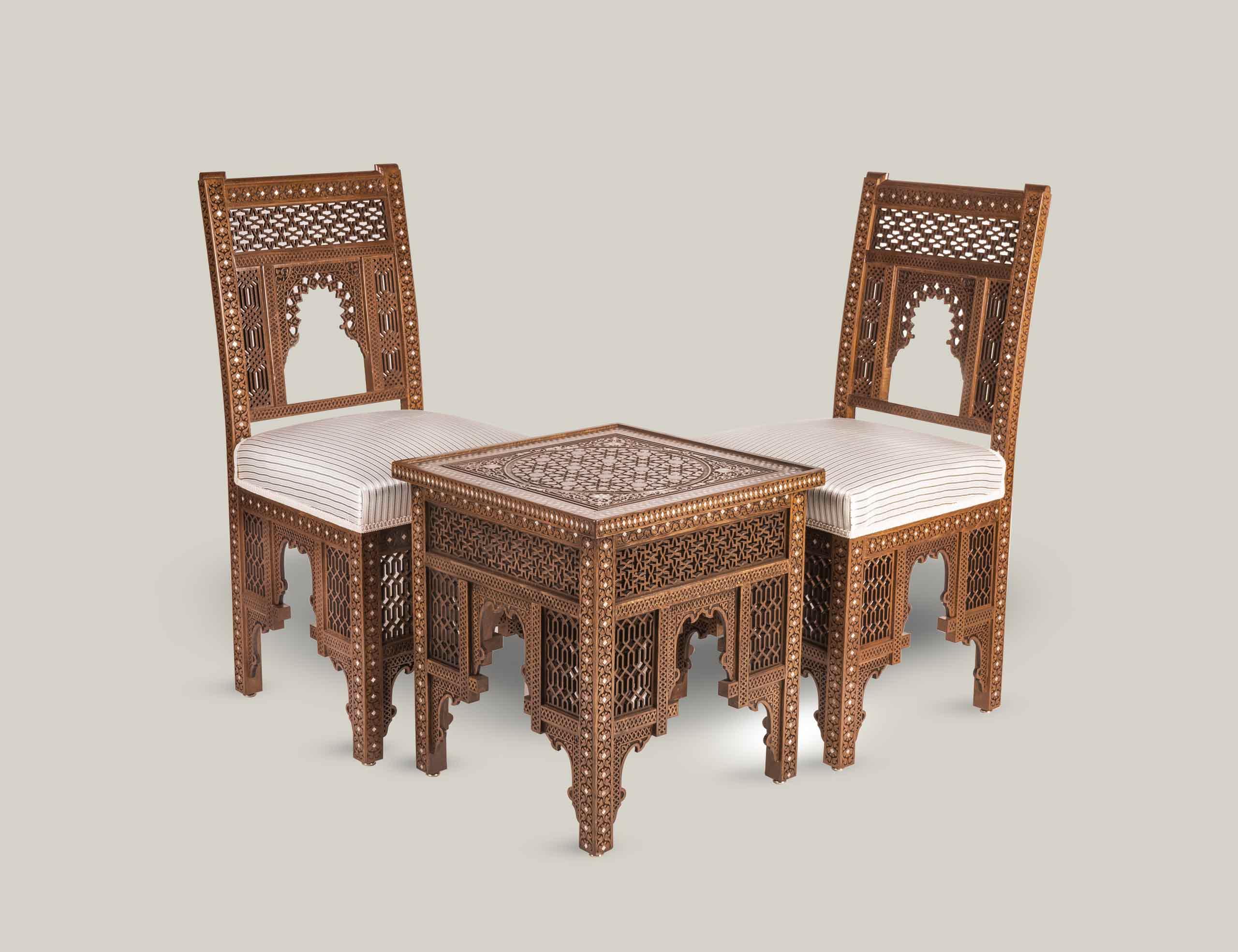
Short answer: genuine mother-of-pearl inlay is made of thousands of small, hand-cut pieces of natural shell set one by one into wood. You can recognise it by the way the colour shifts as you move, by tiny differences between neighbouring pieces, by a cool touch, and by solid weight. Printed films, resin and plastic look flat, perfectly uniform and feel light or warm. Below is a simple checklist you can use in a showroom or when buying online.

Why it matters
Mother-of-pearl furniture is a significant purchase. A hand-inlaid dining table can carry well over a thousand individually set shell pieces, and that labour is what you are paying for. Imitations have become very convincing in photos, so it is worth knowing what to look for before you buy, whether from us or anyone else. For prices, see our mother-of-pearl furniture price guide.
The 7-point checklist
1. Watch how it catches the light
Natural shell has depth. As you walk past a genuine piece, each fragment glows, darkens and changes tone between white, pink, green and blue. Printed or resin "pearl effect" surfaces reflect light evenly and look the same from every angle.
2. Look for small differences between pieces
Every fragment of real shell is cut by hand, so no two are identical. Look closely at a repeating pattern: the shapes match, but the colour, grain and shimmer of each piece vary slightly. A pattern where every tile is exactly the same colour and texture is a strong sign of a print or moulded panel.
3. Touch it
Shell feels cool when you first touch it and warms slowly under your hand. Plastic and resin feel neutral or warm straight away.
4. Feel the weight
Solid wood and real shell make a piece heavy. Genuine inlaid furniture feels dense and sounds solid when you knock on it gently. A light piece or a hollow, plasticky sound suggests a veneer over board or a synthetic surface.
5. Check the seams and finish
Good hand inlay sits level with the surface, with tight joints between shell and wood and no glue marks or air bubbles. Edges should be clean and the frame joinery sturdy. Gaps, lifted pieces or a thick, glassy coating hiding the surface are warning signs.
6. Ask how many pieces it has
Makers who set shell by hand usually know the count, because it determines how long a piece takes. For example, our Rimmon crown mirror carries 59 hand-set pieces, the Dimash side table 792, and the Qanadil dining table between 1,061 and 2,051 depending on its size. A seller who cannot tell you anything about the inlay is a reason to ask more questions.
7. Read the product description carefully
Phrases like "pearl effect", "shell look", "mother-of-pearl style" or "faux nacre" usually mean the surface is not real shell. Other red flags online: no close-up photos, the same stock photo used for several products, and a price that seems too low for hand-inlaid work.

Real shell vs common imitations at a glance
| Genuine hand-set shell | Printed film or resin | |
|---|---|---|
| Light | Shifts colour as you move | Flat, same from every angle |
| Pieces | Each slightly different | Identical, perfectly repeated |
| Touch | Cool at first | Neutral or warm |
| Weight | Heavy, solid sound | Lighter, hollow sound |
| Surface | Level, tight seams | Often a thick glossy coat |
| Seller can give a piece count | Usually yes | Rarely |
How ZW pieces are made
Every ZW piece is hand-carved in solid wood, mainly pitch pine, and inlaid by master artisans from Damascus, using techniques passed down in the city's workshops. The shell is cut into small shapes and set by hand into channels carved in the wood, forming the geometric stars, arches and calligraphy you see on our dining tables, mirrors and backgammon sets and mosaic boxes. We list the inlay count on our larger pieces so you know exactly what you are buying. Read how Damascene furniture is made.

Frequently asked questions
Is mother-of-pearl the same as pearl?
No. Mother-of-pearl (nacre) is the iridescent inner layer of certain shells. Pearls form inside the shell; mother-of-pearl lines it. Furniture inlay uses thin pieces cut from that inner layer.
Can mother-of-pearl furniture be used every day?
Yes, with sensible care. Use coasters and placemats, wipe spills promptly with a soft, slightly damp cloth, avoid harsh cleaning chemicals, and keep the piece out of long hours of direct sun. See our care guide.
Why is genuine inlaid furniture expensive?
Because almost all the value is hand labour: carving the wood, cutting the shell and setting each piece. A large dining table can hold more than 2,000 pieces, each placed by hand.
Why do two "identical" inlaid pieces look slightly different?
That is a sign of authenticity. Natural shell varies in colour, and hand-setting means no two pieces come out exactly alike.
Where can I see genuine mother-of-pearl furniture in the UAE?
You can browse the full ZW collection online and contact us to ask for close-up photos or videos of any piece before you buy. New to the subject? Start with the mother-of-pearl furniture buyer's guide.