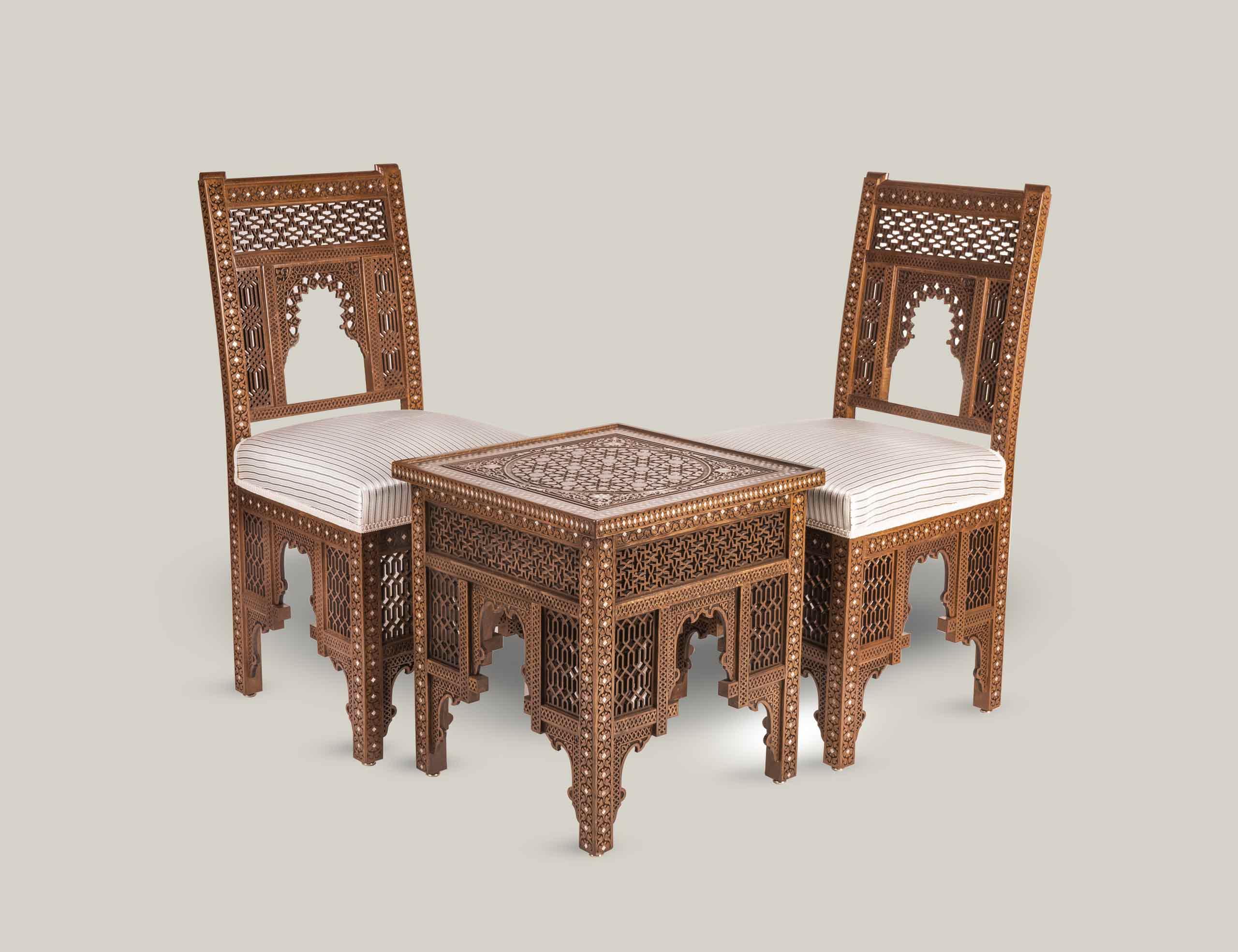
Short answer: Damascene furniture is hand-made wooden furniture in the tradition of the old workshops of Damascus. It is known for shimmering mother-of-pearl inlay set into carved wood, in geometric stars, floral arabesques, arches and Arabic calligraphy. Real pieces are made slowly: the wood is carved and dried, the pattern is cut, and every piece of shell is set by hand. This guide explains where the style comes from, how to recognise its patterns, which pieces suit a modern Gulf home, and how to care for them.

What is Damascene furniture?
"Damascene" simply means "from Damascus", one of the oldest continuously inhabited cities in the world and a centre of fine craft for centuries. The word is used for several crafts linked to the city, from metalwork to textiles. In furniture it describes wooden pieces decorated with inlay, above all mother-of-pearl, often combined with wood veneers, bone and fine metal wire.
What sets it apart from other decorated furniture is how much of the surface is covered. On a classic Damascene table or mirror, the shell is not a small accent: it flows across the whole piece in repeating patterns, so the furniture glows and changes colour as you walk past it. For buying advice, prices and delivery, see the mother-of-pearl furniture buyer's guide.
A short history
- Early forms: inlay was first used on smaller objects such as boxes, small chests and Qur'an stands, before spreading to full-size furniture.
- The 19th century: Damascus inlay reached its peak as trade with Europe grew. Travellers in the early 1890s described inlay workshops lining the old city's main market street, and Damascene pieces were shown among the Ottoman exhibits at the 1893 World's Fair in Chicago.
- European influence: workshops adapted their craft to new shapes such as sideboards, consoles and large tables, while keeping traditional Islamic patterns.
- Today: the craft has been revived, with commissions for palaces, villas and hotels across the Gulf. Historic pieces can still be seen in museums and palace collections around the region.
Materials: what genuine pieces are made of
- Solid wood: the base must be strong and stable, because it carries hundreds or thousands of inlaid pieces. Traditional workshops used hardwoods and fruitwood veneers. ZW pieces are carved in solid pitch pine, chosen for its strength and warm grain.
- Mother-of-pearl: the iridescent inner layer of seashells, cut into thin pieces. Its natural colour shifts between white, pink, green and blue.
- Accents: some designs add bone, contrasting wood mosaic or fine metal wire around the shell.
If a description talks about "pearl effect", "shell look" or "faux nacre", it is not genuine inlay. Our guide to spotting real vs fake mother-of-pearl furniture gives a 7-point checklist.
The signature patterns and what they mean
Geometric stars
Interlocking stars and polygons are the heart of Islamic design. They repeat endlessly, a symbol of order and infinity. You will see them on table tops, backgammon boards and carved screens such as the Sitara star-carved room divider.
Floral arabesques
Flowing vines, leaves and blossoms that curl into each other. They soften the geometry and often frame mirrors and chair backs, as on the Rimmon crown mirror and the Zemira floral room divider.
Arabic calligraphy
Angular Kufic script is a favourite for borders because its straight lines suit inlay. Our Salema coffee table with Kufic centrepiece spells "Ahlan wa Sahlan" (welcome), a fitting message for the centre of a majlis.

Arches, lattices and crowns
Pointed arches, latticework inspired by mashrabiya screens, and tall carved crowns on mirrors borrow from traditional architecture. See the lattice panels of the Arvad room divider and the crown of the Arabesque wall mirror.
Damascene furniture by type
| Type | Where it works | ZW examples |
|---|---|---|
| Dining tables and sets | Formal dining rooms, family gatherings, Ramadan hosting | Qanadil table in 160, 200, 300 and 420 cm, with 1,061 to 2,051 hand-set pieces; dining sets for 6 to 16 guests |
| Chairs and seating corners | Dining rooms, reading corners, entrance halls | Dimash chairs, Qanadil chairs, Dimash seating corner |
| Coffee and side tables | Majlis, living rooms, beside a sofa or bed | Salema coffee tables (122 × 122 cm), Dimash side table with 792 pieces |
| Wall mirrors | Entryways, above consoles, majlis walls | Tamra (23 pieces), Rimmon (59 pieces), all crown mirrors |
| Room dividers | Separating a majlis, hiding a dining or prayer corner | Anbar, all paravans |
| Backgammon sets and boxes | Gifts, display, everyday play | Backgammon sets and mosaic boxes |

How a piece is made
A Damascene piece is made in four stages: the wood is carved and shaped, then left to dry so it will not bend; the channels for the pattern are cut with precision; and finally our artists set each piece of mother-of-pearl by hand. The drying alone is the reason good pieces take months, not weeks. Made-to-order pieces take two to four months. Read the full story in how Damascene mother-of-pearl furniture is made.
Bringing Damascene furniture into a modern home
- Let one piece lead. A large dining table, a crown mirror or a carved screen is a statement on its own. Keep walls and textiles calm around it.
- Use it where guests gather. The majlis and dining room are natural homes for inlaid furniture, because that is where it is seen and admired. See the Arabic majlis design guide.
- Mix with simple modern pieces. A plain sofa next to a Salema coffee table, or a minimal console under a carved mirror, looks fresh rather than heavy.
- Measure first. Our majlis and dining room size guide shows table sizes per guest, coffee table spacing and mirror proportions.

Caring for Damascene furniture
- Keep it away from direct sunlight to prevent fading or warping.
- Use coasters, placemats or a tablecloth, and avoid placing hot or wet items directly on the surface.
- Dust with a soft, dry cloth. For deeper cleaning, use a damp cloth with mild, non-abrasive soap, then dry immediately.
- Avoid harsh chemicals, ammonia-based cleaners and excess water, which can damage the finish.
Full routine in our care guide for the Gulf climate.
Frequently asked questions
What is Damascene furniture?
Wooden furniture made in the tradition of the Damascus workshops, decorated with mother-of-pearl inlay in geometric, floral and calligraphic patterns.
Why is it called "Damascene"?
Because the style developed in the old city of Damascus, whose inlay workshops became famous in the 19th century.
Is Damascene furniture handmade?
Genuine pieces are. The wood is carved by craftsmen and every piece of mother-of-pearl is set by hand. Precise machine work is used only to cut the channels for the pattern.
Is the mother-of-pearl real?
In genuine Damascene work, yes: it is natural shell, which is why the colour shifts as you move. ZW lists the number of hand-set pieces on its larger designs.
How long does it take to make?
Several months, mainly because the wood must dry before the inlay begins. Made-to-order ZW pieces take two to four months; many designs are also kept in ready stock in the UAE.
Where can I buy Damascene furniture in the UAE?
You can browse the full ZW collection online, with free delivery within the UAE. Contact us for close-up photos, a video viewing or a custom size. Furnishing a villa, palace or hotel? Read the project procurement guide.
Historical background: AramcoWorld, July/August 1994, and travellers' accounts of the Damascus markets from the 1890s.